Business Trip to China: What to Arrange Before You Fly
By Charis Li
Most guidance written for visitors covers etiquette, packing and payment apps, then stops. It rarely answers the question that decides how the week goes: where the meetings actually happen, and where you work in the hours between them.
The same guidance will tell you that hierarchy, formality and presentation determine whether you are taken seriously, then say nothing about the most visible signal of all, which is the room you are sitting in.
In short:
- Meetings frequently happen over lunch and dinner rather than in a boardroom, and the table is often where decisions are actually discussed
- A hotel lobby is a weak setting for a first meeting with a new counterparty
- Mobile payments and messaging should be set up before departure, not on arrival
- Something will be added to your schedule at short notice, so leave gaps
- Two periods of the year are worth avoiding entirely
Where Business Actually Gets Done
The expectation of a formal boardroom often does not match the reality. Visitors regularly find that lunches and dinners carry more weight than the scheduled meeting, and that hosts treat shared meals as the substantive part of the visit rather than a courtesy around it.
Equally common is the opposite experience. A visitor arrives expecting a week of banquets, is walked from the hotel to a nearby office, works late alongside the local team with food brought in, and is otherwise left to their own devices. Neither pattern signals how the relationship is going. Both are normal.
Your schedule will be less predictable than it looks on paper. Build in slack, and avoid evening arrangements that cannot be moved.
Choosing Somewhere to Meet Without a Local Office
If your company has no premises in China, the default options are a hotel lobby, a café, or your counterparty's office. The third is fine and often preferable. The first two are weaker than most visitors realise for a first meeting, because they are noisy, semi-public, and offer no way to present materials or hold a confidential conversation.
There is also a practical problem between appointments. A morning meeting in one district and an afternoon meeting in another leaves several hours in which you need somewhere to take a call, print a document, or prepare, and a hotel room across the city is rarely convenient.
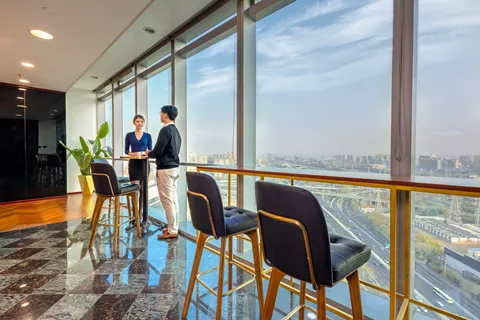
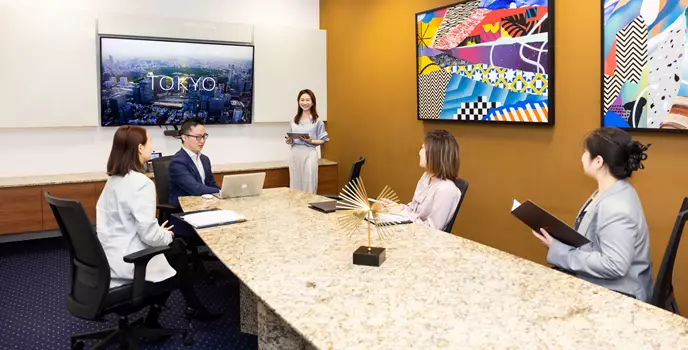
Booking a professional room for the meeting itself solves both problems at once, and for a visitor with no premises in the country it is the most straightforward option available. Servcorp has four addresses in China, each offering meeting rooms, boardrooms and private day offices bookable by the hour or the day. In Beijing, Fortune Financial Centre on Middle Dongsanhuan Road and China Central Place on Jianguo Road are both in Chaoyang District. In Shanghai, One Museum Place sits on Xinzha Road in Jing'an and Citigroup Tower on Huayuanshiqiao Road in Pudong. All four are in the districts where your counterparty is most likely to be based, and rooms can be booked directly for the hours you need them.
What Booking a Room Gives a Visitor
For a few days in the country, the value is less the room than what comes with it:
- A setting that signals the meeting is being taken seriously, in a building your counterparty will recognise
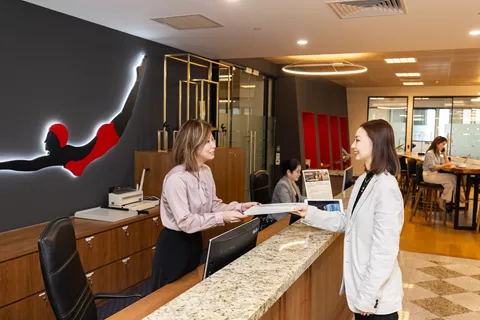
- Bilingual reception staff who greet your guest by name and show them in, which removes the awkwardness of meeting a stranger in a lobby
- Somewhere to print, take a call or prepare between appointments, rather than returning to a hotel across the city
- Booking by the hour, from ¥540, so a ninety-minute meeting does not require committing to a day or a lease
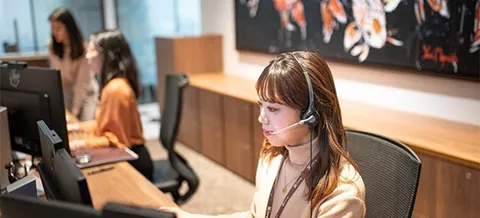
- Secretarial and IT support on site if a document needs handling or a video call needs setting up
- The same arrangement in both cities, and in over 150 locations worldwide when the next trip is somewhere else
Where Meetings Cluster in Beijing
Most international business is concentrated in Chaoyang District, around the Guomao and Jianguo Road corridor, where a large share of multinational offices and the better-known towers are located. Financial Street in Xicheng District is the centre for banking and regulatory bodies. If your counterparty is in one of these areas, meeting nearby saves an unpredictable cross-city journey.
Where Meetings Cluster in Shanghai
Lujiazui in Pudong is the financial district and carries the most weight for banking and professional services meetings. On the Puxi side, Jing'an and the Nanjing West Road corridor hold a large concentration of corporate and commercial offices and are generally easier to reach from the city centre. The two sides of the river are further apart in practice than they appear on a map.
What to Arrange Before You Fly
Setting Up Mobile Payments Before You Land
China is close to cashless. Many restaurants, shops and taxis expect payment by QR code, and some vendors cannot process a foreign card at all. Set up a mobile payment app and link an international card before departure rather than attempting it on arrival, since verification steps are easier to complete on a familiar connection. Carrying a modest amount of cash as a fallback remains sensible.
Keeping Email and Calls Working
Many services common in Western offices are not accessible from a mainland connection, which affects email, file storage, video calls and maps. International roaming from your home carrier, or a travel data plan arranged before departure, is the straightforward way to keep working, and is worth confirming with your provider rather than assuming.
Business contact details are commonly exchanged through a messaging app rather than by email, so have one installed and working before your first meeting.
Entry Requirements
Entry rules have changed materially in recent years, including the expansion of visa exemption arrangements and transit provisions, and eligibility varies considerably by nationality and by purpose of travel. Several widely read guides currently carry outdated information on this. Check the current position directly with the Chinese embassy or consulate for your country before booking, rather than relying on a general article, including this one.
Meeting Conduct That Genuinely Matters?
Advice to "respect the culture" is not much use on a first visit. These are the mechanics.
Seniority and Seating
The most senior person is greeted first and addressed by title and surname rather than given name. Wait to be shown where to sit rather than choosing a seat, in the meeting room and at dinner, since seating position carries meaning in both settings.
Declining a Drink Without Causing Offence
Lifting your glass and drinking can oblige everyone at the table to empty theirs with you, so a casual sip is not always read as casual. Baijiu is considerably stronger than its appearance suggests and is not a wine.
If you would rather not drink, say so early, before the first toast rather than during the third. Stating a straightforward reason and continuing to participate by raising a glass of tea or water is generally accepted without difficulty. Declining once the round is underway is harder than declining at the start.
Business Cards and Contact Details
Printed cards matter less than they once did. Contact details are now frequently exchanged by scanning a messaging app code, and some counterparts no longer carry cards. Bring them anyway, printed in English and Simplified Chinese, present and receive them with both hands, and look at a card before setting it down rather than pocketing it immediately.
When Not to Travel?
Chinese New Year falls between late January and late February depending on the year, and much of the country stops for a week or more, with factories often closed considerably longer. The National Day holiday in the first week of October has a similar effect. Travel and accommodation are more expensive and harder to book around both, and counterparties will be unavailable.
Business hours are otherwise conventional, typically 8.30 am to 5 pm on weekdays, though a long midday break is common and worth checking before scheduling a lunchtime meeting.
Final Thoughts
The preparation that pays off is mostly unglamorous, and most of it happens before departure rather than on arrival.
The exception is where you meet. It is the arrangement most visitors leave to chance, and the one that most affects whether a first meeting is taken seriously. Booking a room by the hour in the district your counterparty works in costs very little to arrange and removes the question entirely.
Contact Us
If you’ve got any questions call us or fill in your information below and we’ll get back to you shortly.